

 English
 Polski
S19 Rzeszów Południe–Babica: installation of the tunnel’s concrete lining completed
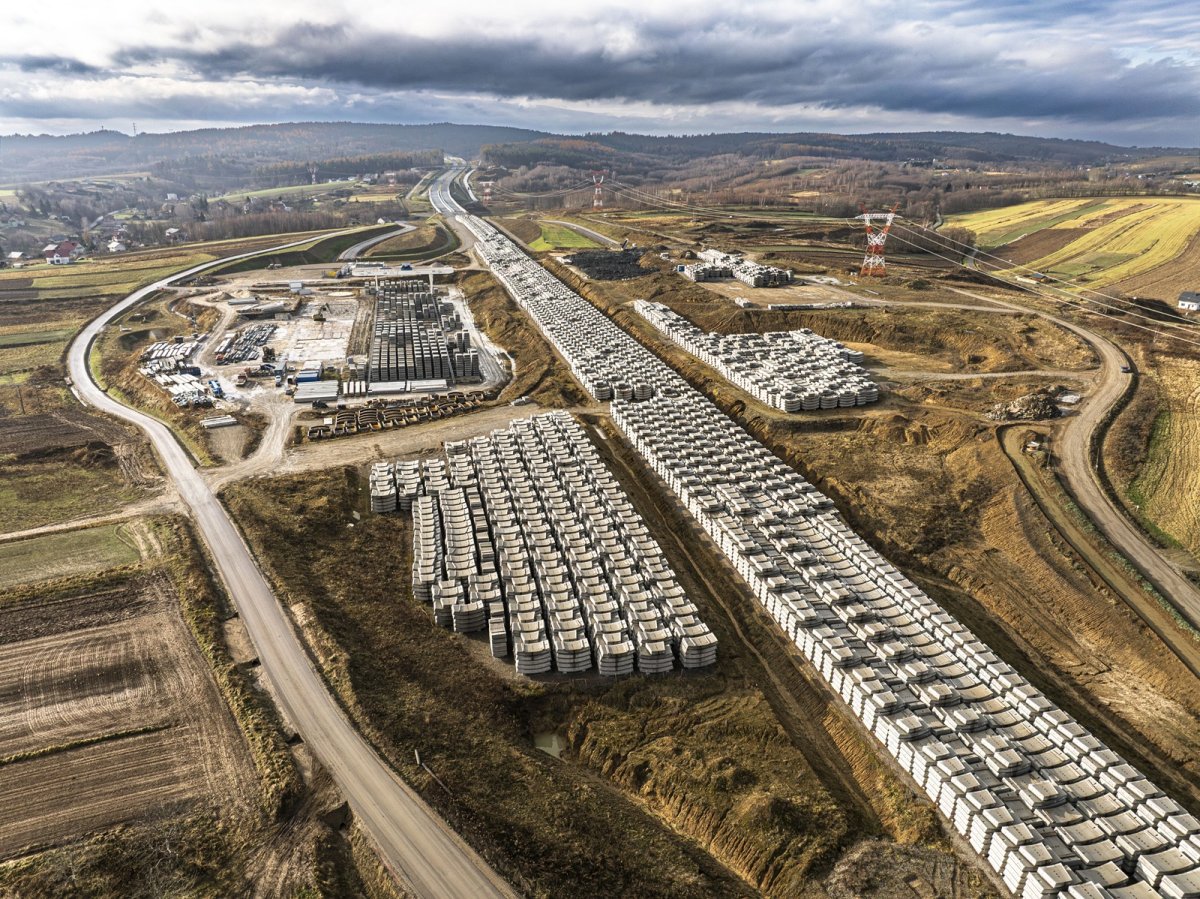
The project contractors—the consortium of Mostostal Warszawa and ACCIONA—have completed a key stage in the construction of the tunnel on the S19 Rzeszów Południe–Babica section. The last, 11,020th concrete segment forming the tunnel’s internal lining has been installed.
Over 11,000 prefabricated tunnel lining segments
A total of 11,020 prefabricated concrete lining segments, known as tubings, were used to build the concrete lining of the first tunnel bore. These segments were assembled into tunnel rings. The elements were manufactured in a specially prepared prefabrication hall in Lutoryż, located directly at the construction site, then transported to the TBM and installed continuously during excavation.
Each lining ring consists of 10 segments, forming a tight and durable structure designed to withstand difficult geological conditions.
Concrete lining completed after the historic breakthrough
The completion of the concrete lining of the first bore followed the historic breakthrough of the tunnel. On 10 December this year, the TBM “Karpatka” broke through to the northern portal, completing the excavation of the first bore with a length of over 2,200 meters. This was one of the most important milestones of the project and the first tunnel project of this kind in the region carried out using a TBM.
- The completion of excavation of the first tunnel bore shows that good cooperation, commitment, and significant financial investment can deliver results we can be proud of across Europe. We are proud that construction is moving forward. We are fully aware of the difficulties and requirements involved. I would like to thank all the engineers, designers, and specialists thanks to whom we can now speak about the completion of this stage - said Dariusz Klimczak, Minister of Infrastructure, during a visit to the construction site.
- The completion of excavation of the first tunnel bore proves that Mostostal Warszawa S.A. and ACCIONA keep their word and are capable of delivering the most demanding projects in Poland. It also confirms that Polish engineering can successfully tackle the most challenging technological tasks - said Jorge Calabuig Ferre, President of the Management Board of Mostostal Warszawa S.A.
TBM “Karpatka”
The TBM “Karpatka” is one of the largest and most advanced machines of its kind used in Poland. It is 114 meters long and 15 meters wide, with a weight of approximately 4,400 tonnes, illustrating the scale of the undertaking involved in constructing the S19 tunnel. It is equipped with a hydraulic-electric drive and 12 motors, each with a power of 1 MW, providing the force required to operate in exceptionally difficult geological conditions.
At the heart of the machine is a cutting wheel weighing around 400 tonnes, rotating at up to 3 revolutions per minute and fitted with 471 cutting tools, enabling effective excavation of the rock mass. During works, the TBM reached a maximum depth exceeding 100 meters below ground level.
Geological challenges and advanced TBM technology
The tunnel construction was a major challenge, requiring work in the complex geological conditions of the Carpathian flysch and addressing the risk of methane. Advanced detection and ventilation systems, as well as detailed safety procedures, were implemented. Works were carried out around the clock by specialized teams of engineers, operators, and technical staff.
Transport of the TBM
Transporting the massive TBM to Poland was an enormous logistical operation—the largest road transport project carried out in Poland to date. The machine first arrived by sea at the port of Szczecin from Santander, Spain. Its components were then transferred onto barges and pontoons and transported along the Oder River to Opole. The next stage involved road transport from Opole to the construction site in Babica. To minimize traffic disruptions along the designated route, the machine was transported exclusively at night. The transport was extremely spectacular, capturing nationwide attention. Hundreds of local residents watched live as the transport team demonstrated extraordinary precision.
Tunnel as a key element of the S19 section and the Via Carpatia corridor
The Babica tunnel is 2,255 meters long and will ultimately consist of two one-way bores, connected by 15 cross passages and an emergency crossover. Each bore will have two traffic lanes and an emergency lane. The tunnel is the most important and technologically advanced element of the 10.3-kilometer S19 expressway section, which forms part of the international Via Carpatia transport corridor.
Next stages of work
Following the completion of excavation, the next stage will be turning the TBM “Karpatka” to enable excavation of the second bore. The start date of these works will depend on the results of the machine’s technical inspection, the scope of necessary repairs, and planned modifications to improve performance. The rotation of the TBM “Karpatka” will be carried out using an airmover system at the northern portal.
Investment by the Mostostal Warszawa–ACCIONA consortium
The investment carried out by the consortium of Mostostal Warszawa S.A. and ACCIONA is one of the most important and technologically advanced infrastructure projects in Poland. Its value exceeds PLN 2 billion, and it is being implemented on behalf of the General Directorate for National Roads and Motorways (GDDKiA). The project will significantly improve road safety, reduce travel times, and strengthen transport accessibility for the region and the entire Via Carpatia corridor.
photo. MW